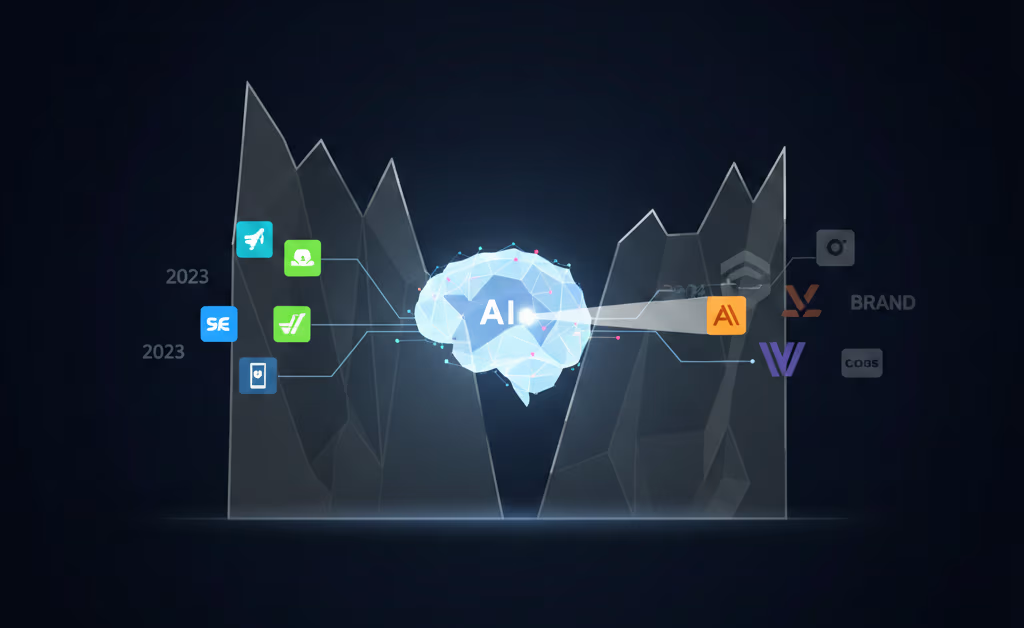
If you have ever asked an AI assistant about a company, product, or trend and received an answer that felt outdated or incomplete, you have already experienced the impact of knowledge cutoffs.
As tools like ChatGPT, Gemini, and Claude become everyday search alternatives, brands are beginning to realize an uncomfortable truth. AI answers are not always current, and that directly affects visibility, accuracy, and trust.
Understanding how knowledge cutoffs work is the first step toward fixing that problem.
How Large Language Models Learn About the World
Large language models do not learn continuously. They are trained in massive batches using historical data from the web, books, documentation, and structured sources. Once training ends, the model's internal understanding of the world is frozen at that point in time.
That stopping point is known as the knowledge cutoff.
Anything that happens after this date is not part of the model's native knowledge. Product launches, rebrands, regulatory changes, pricing updates, and even entirely new companies may be invisible to the model unless additional systems are involved.
This limitation is not a bug. It is a design reality.
Why Knowledge Cutoffs Matter More Than Ever in 2025
AI tools are no longer novelty products. ChatGPT becoming one of the most downloaded apps in the world signals a major behavioral shift. People are asking AI for recommendations, comparisons, and decisions that previously belonged to search engines.
For brands, this changes the rules.
Visibility is no longer just about ranking on page one of Google. It is about being included in AI generated answers. If a model's training data does not strongly recognize your brand or understand what you do, you may simply not exist in those answers.
This is where knowledge cutoffs quietly shape outcomes.
A Snapshot of Knowledge Cutoff Timelines Across AI Models
Different AI models were trained at different times, which explains why the same question can produce different answers across platforms.
Some examples include:
- Newer OpenAI models trained into late 2024
- Gemini and Claude models trained largely in 2023
- Open source models like Mistral trained much earlier
- Emerging models like DeepSeek trained more recently
These differences mean one model may recognize your brand while another does not, or may describe it using outdated information.
For marketers, this inconsistency is a visibility risk.
The Real Issue Is Not the Cutoff, It's Authority
Here's the key insight most brands miss.
Knowledge cutoffs do not automatically exclude you. Weak authority does.
AI models rely heavily on repeated, consistent, well structured information across trusted sources. If your brand appears clearly and consistently in authoritative content before or around a model's training window, it is far more likely to be referenced accurately.
If your content is scattered, vague, or poorly structured, the model has nothing solid to anchor to.
This is why some newer brands still appear in AI answers while older ones disappear.
How Brands Can Influence AI Visibility Despite Cutoffs
You cannot change when an AI model was trained, but you can influence what it recognizes.
Strong AI visibility comes from:
- Clear entity definition across your website
- Factual, concise explanations of what you do
- Structured content like FAQs, tables, and summaries
- Consistent brand mentions across credible sources
- Topical depth instead of surface level content
These elements make it easier for AI systems to extract, remember, and reuse your information when generating answers.
Where LLMRankr Comes In
Understanding knowledge cutoffs is only useful if you can measure their impact.
LLMRankr helps brands see how they actually appear across AI systems. Instead of guessing, you can track:
- Whether your brand is mentioned or ignored
- How accurately AI describes your offering
- Which competitors are being cited instead
- Where content structure or clarity is breaking down
This allows brands to optimize not just for search engines, but for AI answer selection itself.
In an environment shaped by knowledge cutoffs, visibility is earned through structure and authority, not just freshness.
Turning a Limitation Into an Advantage
Brands that understand how AI learns can work with the system instead of fighting it.
By focusing on clear positioning, consistent messaging, and machine readable content, you increase the likelihood that future AI models will recognize and trust your brand, regardless of cutoff dates.
Knowledge cutoffs may limit what AI knows, but they do not limit who AI chooses to cite.
Final Takeaway
Knowledge cutoffs explain why AI answers are sometimes outdated, but they also highlight a larger shift. Brands must actively shape how machines understand them.
Those who invest early in AI visibility, authority building, and structured content will not just survive this shift. They will lead it.
That is exactly the problem LLMRankr was built to solve.